
Filament Winding, 3D Winding & Multi-Axis Winding

Precision Winding for Advanced Composites

Cygnet Texkimp is a global leader in filament winding and fibre placement technologies, combining decades of expertise in fibre handling and process control to deliver precision-engineered systems.

Our winding technologies are used to create strong, lightweight, and high-performance composite parts for markets including aerospace, automotive, energy, marine, and construction.

From straight tubes to complex 3D geometries — we wind with precision, consistency, and speed. Our winding technologies are used globally to produce components for:
  • Aerospace: spars, fuselages, and ducts

  • Automotive: crash beams, drive shafts, pressure vessels

  • Energy: wind-turbine blades, hydrogen storage tanks, oil & gas pipes

  • Marine & Construction: masts, tubes, composite supports

  • Aerospace: spars, fuselages, and ducts

  • Automotive: crash beams, drive shafts, pressure vessels

  • Energy: wind-turbine blades, hydrogen storage tanks, oil & gas pipes

  • Marine & Construction: masts, tubes, composite supports

Why Choose Cygnet Texkimp Winding Systems

  • Proven expertise in fibre placement and tension control
  • High-speed, high-precision systems engineered for scalability
  • Compatibility with dry, prepreg, and thermoplastic fibres
  • Integration with automation and resin impregnation systems

  • Access to secure R&D trials at our Innovation Centre

  • Proven expertise in fibre placement and tension control
  • High-speed, high-precision systems engineered for scalability
  • Compatibility with dry, prepreg, and thermoplastic fibres
  • Integration with automation and resin impregnation systems

  • Access to secure R&D trials at our Innovation Centre

Filament winding is a method of winding fibres under tension around a rotating mandrel to create composite structures of exceptional strength and accuracy. Cygnet Texkimp’s range of filament winding machines includes standard, high-tension, and fully automated systems with robotic loading and unloading capabilities.
Our technologies are designed to increase productivity, accommodate larger fibre packages, and deliver consistent quality through advanced process control.

Customers can also access secure R&D trials and process validation at our Innovation Centre  in Cheshire, England, equipped with a suite of winding, slitting, and resin-handling technologies .

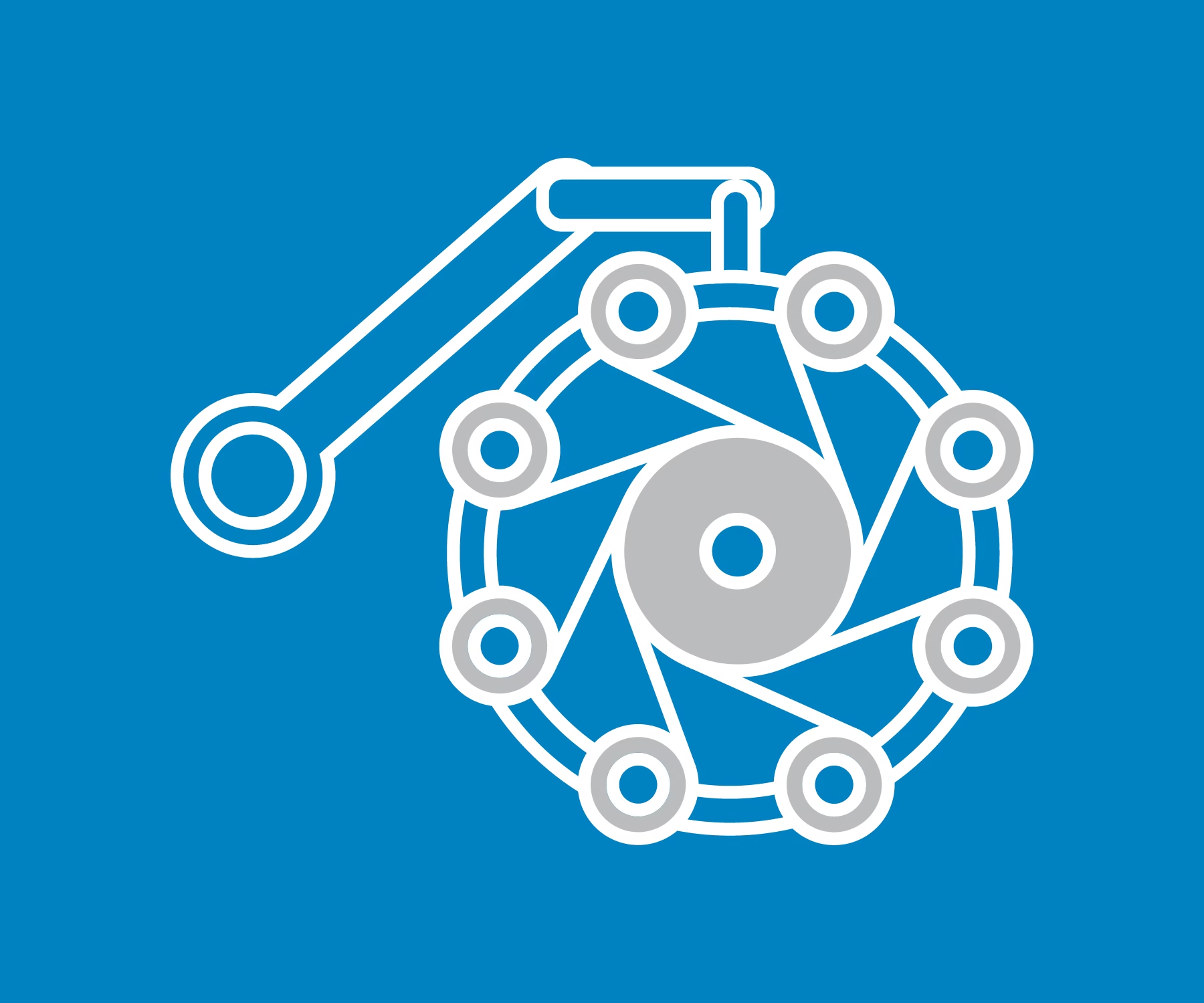
Our Robotic Filament Winder combines traditional winding principles with robotic precision, allowing for greater flexibility in component size, geometry, and complexity.

This system uses a robotic arm to feed fibre from multiple axes into the winding mechanism, enabling precise tension control and high-speed, multi-directional winding.

An optional driven creel allows each fibre position to be tensioned and fed individually, maintaining accuracy even at very high speeds.

Fibres can be impregnated with resin during winding using an integrated metering system, and the machine is compatible with dry fibre, towpreg, or prepreg tapes . Ideal for high-precision winding applications requiring speed, consistency, and flexible geometry control.

Cygnet Texkimp’s 3D Winder is a groundbreaking robotic filament winding system designed for the production of non-linear, curved, or variable cross-section parts. This technology integrates rotation and fibre feed into a single robotic mechanism that moves around a static mandrel, achieving winding speeds exceeding 1 kg of carbon fibre per minute.

Applications include aerospace fuel lines, crash beams, hydrogen storage vessels, wind-turbine blades, and aircraft fuselages — though its potential uses are virtually limitless. Engineered for integration into automated production cells, the 3D Winder enhances throughput, repeatability, and manufacturing flexibility while maintaining the highest precision standards.

The Multi-Axis Winder is a high-speed, linear fibre-winding solution for manufacturing tubes, masts, and cylindrical structures. Engineered for rapid, cost-effective production, it offers a compelling alternative to conventional filament winding and braiding.

Multiple fibre tows are applied simultaneously to create accurate, repeatable composite parts with minimal waste and exceptional consistency.

This system supports both dry fibre and pre-impregnated materials, and like the 3D Winder, can be incorporated into automated production cells with robotic handling for improved process efficiency. Designed for high-rate production of straight or slightly curved components with uncompromising quality and control.